Complexion in NBI Clearance Form: Meaning, Types, and What to Choose
If you have reached the complexion in NBI Clearance field application and are unsure which option to select, the answer is simple: choose the available category that most closely describes your natural skin tone. The six options covered in this guide are Fair, Brown, Dark, Yellow, White, and Red. You do not need to find a perfect match. You need to choose the closest option based on your usual appearance, rather than your nationality, ethnicity, or temporary changes caused by tanning or makeup.
This guide explains what to put in complexion in nbi clearance, how to compare similar choices, what foreign applicants should consider, and how to seek help if you have already submitted an incorrect selection. It also explains what the available NBI documentation says about clearance verification and HIT status.
What Does Complexion In NBI Clearance Form Mean?
Complexion refers to your skin’s general color or tone. On the NBI Clearance application, it is a personal-description field that asks you to select a category matching your appearance.
The purpose of answering this field is to provide a description of yourself as part of your application information. It should not be confused with your nationality, ancestry, skin-care routine, or personal preference.
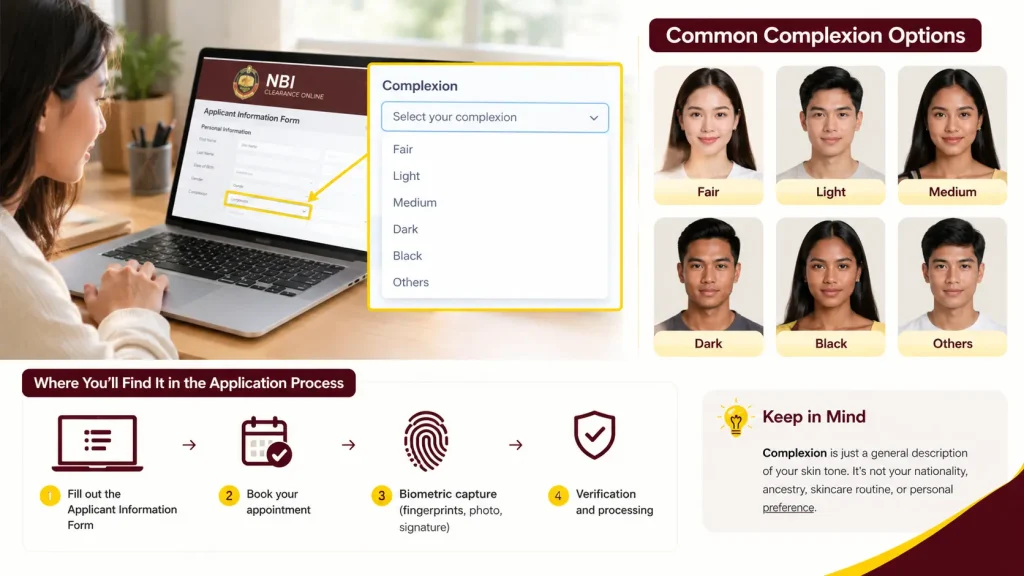
Where Can You Find the Complexion Field?
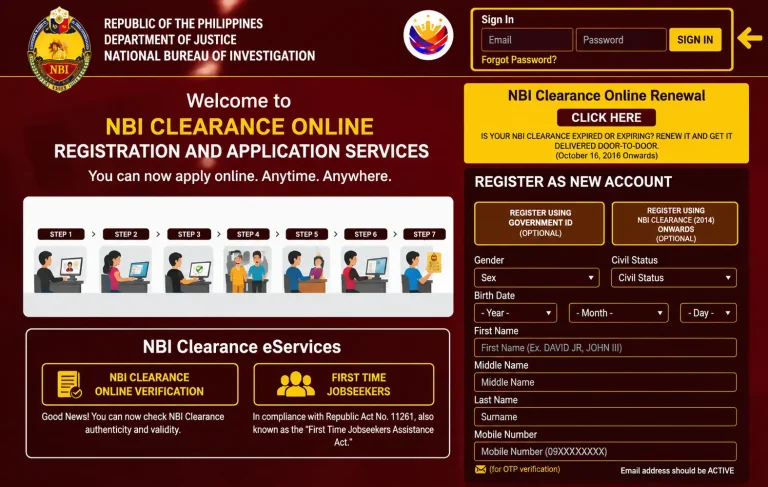
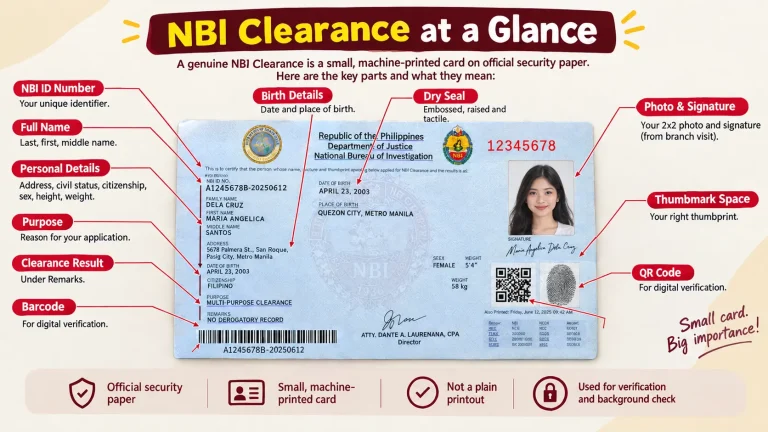
The complexion field belongs to the personal information stage of the application. The NBI application guide explains that applicants complete an Applicant Information Form containing personal details, family background, and education and employment information. It also explains the subsequent appointment, biometric capture, and verification stages.
The NBI Citizen’s Charter separately describes the encoding of personal information and the capture of fingerprints, an image, and a signature during clearance processing. These are distinct parts of the application process. You can access the official NBI Clearance application portal to manage your application.
Why Is Complexion Included in Personal Information?
Complexion provides a general description of your appearance. It is different from biometric information such as fingerprints, and it cannot independently establish someone’s identity. The important point is to provide a reasonable, accurate description rather than spend too much time trying to identify an exact shade. The NBI documentation cited above explains the application and identification process, but it does not provide a precise complexion chart defining every available category. The descriptions in this guide are therefore practical interpretations of the labels, not official NBI definitions.
What Are the Six Complexion Options in NBI Clearance?
The six options discussed here are Fair, Brown, Dark, Yellow, White, and Red. Each represents a broad description that can help you decide which category is closest to your natural skin tone.
Complexion option | Practical description |
Fair | A generally light or pale skin tone. |
Brown | A light-tan, tan, or medium-brown appearance. |
Dark | A deeper brown skin tone, particularly when Brown seems too light a description. |
Yellow | A complexion that appears noticeably yellowish or golden in its overall tone. |
White | A very light or pale-looking complexion. |
Red | A naturally reddish or ruddy-looking complexion rather than temporary redness. |
These descriptions are meant to make the categories easier to understand. They are not official boundaries, and the differences between some options can be subtle.
Fair: A Lighter Skin Tone
Fair generally describes skin that looks light or pale in ordinary daylight. If your everyday skin tone is noticeably light, Fair may be the closest description.
Brown: A Tan or Medium-Brown Tone
Brown generally describes skin that looks tan or brown rather than very light or deeply dark. It may be the closest option for someone who naturally describes their skin as brown, morena, moreno, or kayumanggi. These everyday expressions can vary between individuals, so focus on your actual skin tone rather than a label someone else uses for you.
Dark: A Deeper Brown Tone
Dark generally describes a deeper brown complexion. Consider this option when your natural skin tone appears distinctly darker than the brown description you would otherwise choose. There is no need to compare yourself with photographs under different lighting. The categories are broad, and the closest reasonable match is sufficient.
Yellow: A Yellowish or Golden Appearance
Yellow generally suggests a yellowish or golden cast to the complexion. It is best understood as a description of how the skin appears, not as a measure of whether someone is light-skinned. A person can have a lighter complexion and still notice a yellowish or golden appearance. However, the label alone does not establish a scientific undertone classification.
White: A Very Light or Pale Appearance
White is another light-skin description in the set of options. It may appear similar to Fair, which is why some applicants find these two choices difficult to distinguish. The NBI sources reviewed do not publish a precise cutoff between White and Fair. Choose the closer label rather than assuming that a person’s nationality determines which one applies.
Red: A Naturally Reddish Appearance
Red may be understood as a complexion that looks naturally reddish or ruddy. Temporary redness caused by heat or other short-term changes should not be treated as your usual skin tone. If your skin sometimes appears red but normally looks different, consider your usual appearance rather than a temporary change.
How to Choose the Correct Complexion in NBI Form
The easiest approach is to consider how your skin normally looks and compare it with the descriptions above.
1. Check Your Usual Skin Tone in Natural Daylight
Look at your skin near a window or outdoors in ordinary daylight. Avoid judging it under strongly colored indoor lights, which can alter how colors appear. You are not trying to measure your skin scientifically. You are simply trying to make a fair comparison with the available labels.
2. Compare More Than One Area
Your face, neck, and inner arm can look slightly different because of sun exposure, skincare products, or natural variation. Consider them together instead of relying on a single area, such as the back of your hand. Choose the description that best represents your usual overall appearance.
3. Account for Temporary Changes
A recent tan, sunburn, makeup, or camera filter may change how your skin looks. Do not let one temporary appearance determine your answer if it differs substantially from your normal tone. If you have recently spent time outdoors, consider how your skin generally appears rather than focusing entirely on the most recent change.
4. Use This Quick-Reference Table
The following table provides practical guidance for comparing everyday descriptions with the six form options.
If your skin generally looks like.. | Option to consider |
Light or pale | Fair |
Very light or extremely pale | White |
Tan or medium brown | Brown |
Deep brown | Dark |
Noticeably yellowish or golden in overall appearance | Yellow |
Naturally reddish or ruddy | Red |
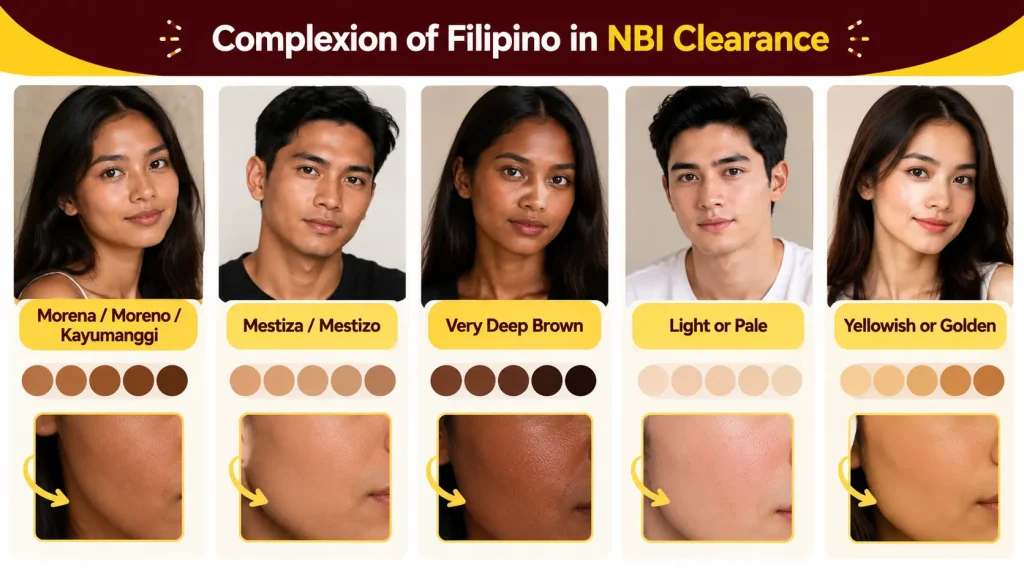
What is Filipino Complexion in NBI clearance Form?
Words such as morena, moreno, kayumanggi, mestiza, and mestizo are used in everyday Filipino conversations, but their meanings can vary. The following image will help you to know which complexion in NBI suits you best as a Filipino.
Everyday description | Practical consideration |
Morena, moreno, or kayumanggi | Brown may be a reasonable option when it matches the person’s natural tone. |
Mestiza or mestizo | These terms do not establish one complexion category; compare the person’s actual skin tone. |
Very deep brown | Dark may be the closer description. |
Light or pale | Compare Fair and White. |
Yellowish or golden appearance | Consider Yellow if that label is the closest match. |
Borderline Cases: When Two Complexions in NBI Seem Right
Sometimes two options appear equally suitable. This is understandable because the categories are broad and the form does not provide an exact shade scale.
Fair vs. White: Which Is Closer?
Fair and White can overlap in ordinary descriptions. Both may suggest lighter skin tones, and there is no verified official NBI shade boundary available in the sources reviewed. Compare the labels in the context of the options actually displayed on your form. Choose the one you believe most closely describes your usual appearance instead of assuming that one label is required for a particular nationality.
Fair vs. Yellow: Lightness or a Yellowish Appearance?
Fair generally describes lightness, while Yellow is more naturally interpreted as a yellowish or golden appearance. These descriptions refer to different aspects of how skin may look, so one should not automatically replace the other. If neither label seems clearly more suitable, choose your best reasonable match.
Brown vs. Dark: Where Does One End and the Other Begin?
Brown describes a brown or tan appearance, while Dark suggests a deeper brown tone. There is no precise boundary between these labels in the official material reviewed. Consider the general appearance of your skin rather than whether you are darker or lighter than a particular relative, friend, or stranger.
Red vs. Temporary Skin Redness
A temporary flush does not necessarily represent your usual complexion. Consider whether your skin typically has a reddish appearance or whether the redness is caused by a temporary condition.
If your usual skin tone does not seem to fit any label, do not invent a seventh category. Select the closest available option or consult NBI for guidance if you cannot reasonably choose.
How Should Foreign Applicants Choose Their Complexion in NBI?
Foreign nationals should focus on their actual skin tone rather than their nationality. A person’s country of origin does not reliably identify their complexion.
Do Foreign Applicants Need a Different Complexion Category?
The complexion options discussed in this article do not establish a separate category based on nationality. If your NBI application presents the six options listed here, compare your natural skin tone with those labels. Do not automatically select White or Fair simply because you are a foreign national. Those options may suit some applicants, but the right choice depends on the individual.
What If None of the Options Seems Suitable?
If you are a foreign applicant and none of the labels seems to fit, choose the closest reasonable description if you can do so confidently. If the categories remain unclear, consult the relevant NBI office or official support channel before making an assumption. Avoid relying on someone else’s selection simply because they share your nationality. Individual skin tones differ, even among people from the same country.
Complexion vs. Skin Type vs. Race and Ethnicity
These terms describe different things. Understanding the distinction can help you avoid confusing the complexion field with information that the form is not asking for.
Term | Meaning |
Complexion | The general color or appearance of your skin. |
Skin type | How skin behaves, such as oily, dry, combination, or sensitive. |
Race or ethnicity | Concepts associated with ancestry, identity, or cultural background. |
Complexion Is Not the Same as Skin Type
Complexion relates to how your skin looks. Skin type describes characteristics such as oiliness, dryness, or sensitivity. For example, two people may have similar skin tones but different skin types. Those skincare characteristics do not determine which complexion label is closest.
Complexion Does Not Determine Your Ethnicity
People of the same ethnicity can have different skin tones, and people from different backgrounds can have similar skin tones. Select the complexion category that best describes your appearance, rather than choosing based on ancestry, nationality, or assumptions about a particular group.
Does Complexion Affect NBI Clearance Approval or a HIT?
A common concern is whether selecting the wrong complexion can cause an NBI Clearance application to be rejected or flagged as a HIT. The important distinction is between an incorrect descriptive detail and the clearance verification process.
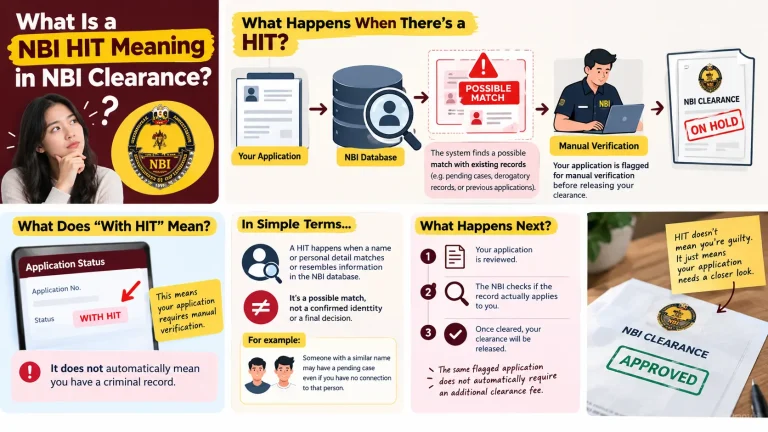
How Does an NBI HIT Work?
A HIT indicates that an application requires further checking because of a possible matching record. The NBI’s published Citizen’s Charter for First-Time Job Seekers describes a verification process in which applications without a hit proceed to printing, while certain applications flagged for Quality Control undergo further verification and an interview.
The HIT process is therefore about checking application records against the NBI’s database. It should not be confused with choosing one complexion label instead of another.
Can an Incorrect Complexion Selection Cause a HIT?
The official NBI materials reviewed do not identify an incorrect complexion selection, by itself, as a trigger for a HIT. They also do not provide a blanket guarantee about how every discrepancy in an application will be handled.
For that reason, it is reasonable not to panic over a minor complexion mistake, but you should still ask NBI staff for guidance if you believe your application contains inaccurate information.
Does Complexion Determine Whether Your Clearance Is Approved?
Do not assume that a particular complexion category automatically qualifies or disqualifies you. The published HIT process focuses on record verification, and the official material reviewed does not establish a complexion-specific approval rule.
If your application receives a HIT, follow the instructions provided by NBI and attend any required verification. Do not conclude that your complexion choice caused the status without evidence.
What to Do If You Selected the Wrong Complexion in NBI Form
If you have already submitted the form and then notice that you selected the wrong option, start by identifying the stage of your application.
If You Notice the Mistake After Submitting Your Application
Check your application status and determine whether you still have an opportunity to review or amend your information through the official portal. Do not submit a duplicate application just to correct a complexion choice unless NBI specifically instructs you to do so. A second application is not a verified correction method.
What Should You Ask at Your Biometrics Appointment?
If you are attending an in-person appointment, explain the mistake to the NBI staff handling your application and ask whether the information can be corrected before processing is completed.
The official NBI application guide describes photo, fingerprint, and signature capture, as well as data verification at the branch. However, the sources reviewed do not explicitly guarantee that staff can change the complexion field on the spot. Follow the instructions given by the office handling your application.
Should You Worry About a Minor Selection Error?
Do not assume that a minor complexion discrepancy will automatically lead to rejection or a HIT. At the same time, do not ignore incorrect personal information if it can be corrected through the appropriate procedure. The practical next step is to ask NBI how to handle the mistake at your current stage instead of submitting another application based on guesswork.
How to Correct Complexion in Existing NBI Records
Correcting an application that has already been submitted is not necessarily the same as changing information associated with an issued clearance.
Correcting the Information During Your Next Renewal
If you need to renew your clearance and the application allows you to review your personal information, check the complexion field before submitting the new application.
Select the option that most closely reflects your usual skin tone at that time. If you have a question about an existing record or a previously issued clearance, contact NBI to determine whether a separate correction is required.
Requesting a Correction Before Renewal Is Due
The official NBI sources reviewed do not publish a specific, complexion-only correction procedure that establishes which branch must process the request or which documents are mandatory for every case.
Before travelling to a branch, contact NBI through its official website or relevant clearance office. Explain that you want to correct a complexion entry in an existing record and ask:
Having a valid ID and a copy of your existing clearance available may help you explain the issue, but confirm the actual requirements with NBI first.
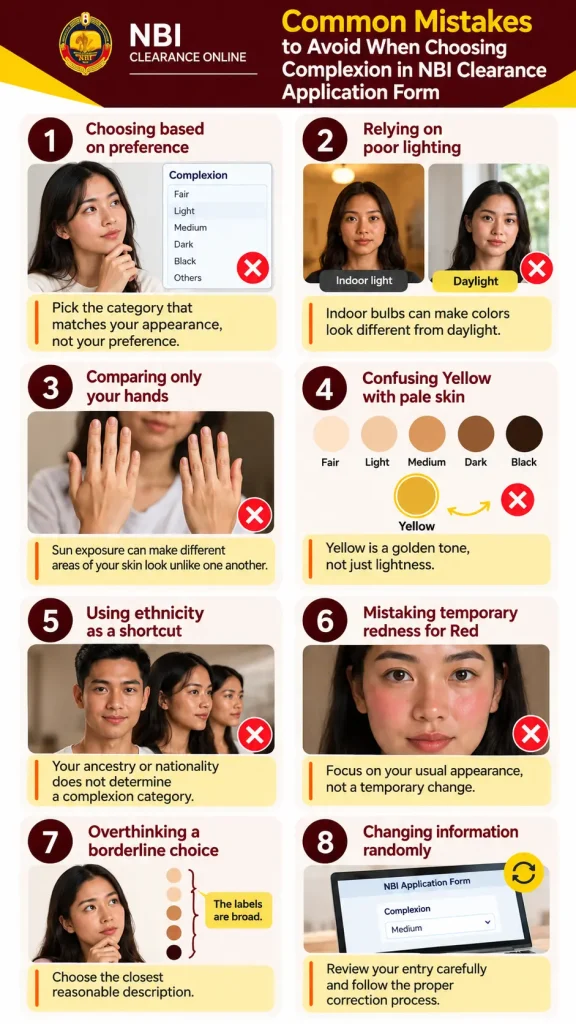
Common Mistakes to Avoid When Choosing Complexion in NBI Clearance Application Form
A few simple mistakes can make an otherwise straightforward form field more confusing than necessary.
Frequently Asked Questions About NBI Complexion
What Does Complexion in NBI Clearance Mean?
Complexion refers to your skin’s general color or tone. You select the option that most closely describes your natural appearance from the categories available on the form.
What Complexion Should I Choose for NBI If I Am Unsure?
Compare your usual skin tone with the six options: Fair, Brown, Dark, Yellow, White, and Red. Use the descriptions in this guide to narrow down your choice, and select the closest reasonable match.
Does Complexion Affect NBI Clearance Approval?
The official NBI materials reviewed do not establish a complexion-specific approval rule. The published HIT process focuses on matching and verifying application records. If you have entered incorrect information, ask NBI how to correct it rather than assuming the mistake will cause rejection.
Is Complexion in NBI is the Same as Skin Type?
No. Complexion describes the general color of your skin, while skin type refers to characteristics such as oiliness, dryness, or sensitivity.
Is Complexion in NBI is the Same as Race or Ethnicity?
No. Complexion describes appearance, while race and ethnicity concern different aspects of identity and background. People of the same ethnicity can have different skin tones.
What Complexion in NBI Do Foreign Nationals Usually Choose?
There is no reliable basis in the official sources reviewed to identify one option as the most common choice for foreign nationals. Choose according to your own skin tone, not your nationality.
What If My Skin Tone Does Not Match Any of the Six Options?
The six labels are broad descriptions, so an exact match may not be possible. Select the closest available option if you can reasonably identify one. If you cannot, ask NBI for guidance instead of inventing a new category.
Can I Correct My Complexion After My Clearance Has Been Issued?
You should contact NBI to confirm the correct procedure for an issued clearance. The official documentation reviewed does not establish a universal complexion-correction process or guarantee that every case can be amended at a particular branch.
Is There a Test for Complexion in NBI?
Complexion is a descriptive field, not a complexion examination. You select the closest available category on the application form.
What Should I Do If I Think I Selected the Wrong Complexion?
Check the stage of your application and ask NBI for the correct next step. If you have an upcoming appointment, raise the issue with the staff handling your application. Do not file a duplicate application unless NBI instructs you to do so.
Conclusion:
Selecting your complexion in the NBI Clearance form becomes easier when you understand the six available options: Fair, Brown, Dark, Yellow, White, and Red. Compare their descriptions with your natural skin tone under ordinary daylight, and choose the closest match rather than worrying about finding an exact shade. Your nationality or ethnicity should not determine your selection, and if two options seem equally suitable, use your best judgment.
If you discover that you selected the wrong complexion, do not panic or assume your application will be rejected. Ask NBI staff how to address the mistake based on your application status, and confirm the correction procedure before taking further action. By reviewing your personal information carefully and following the appropriate guidance, you can complete this part of your NBI Clearance application with greater confidence.