NBI HIT Meaning: What It Is, How Many Days It Takes, and How to Check It
If your NBI Clearance came back marked “HIT,” it means the system found a name or record that resembles yours and needs a human to confirm whether it’s actually you. It is not a criminal record, not a rejection, and not final. Understanding the NBI HIT meaning can help you know why your application needs further verification.
Below is everything you need: what HIT and “With HIT” mean, the two types of HIT, what causes them, how long resolution takes, how to check your status, and the exact steps to clear your name, whether you’re applying in the Philippines or from abroad. A possible match does not automatically mean the record belongs to you. The NBI must verify the details before your clearance can be released.
What Is a “NBI HIT Meaning” in NBI Clearance?
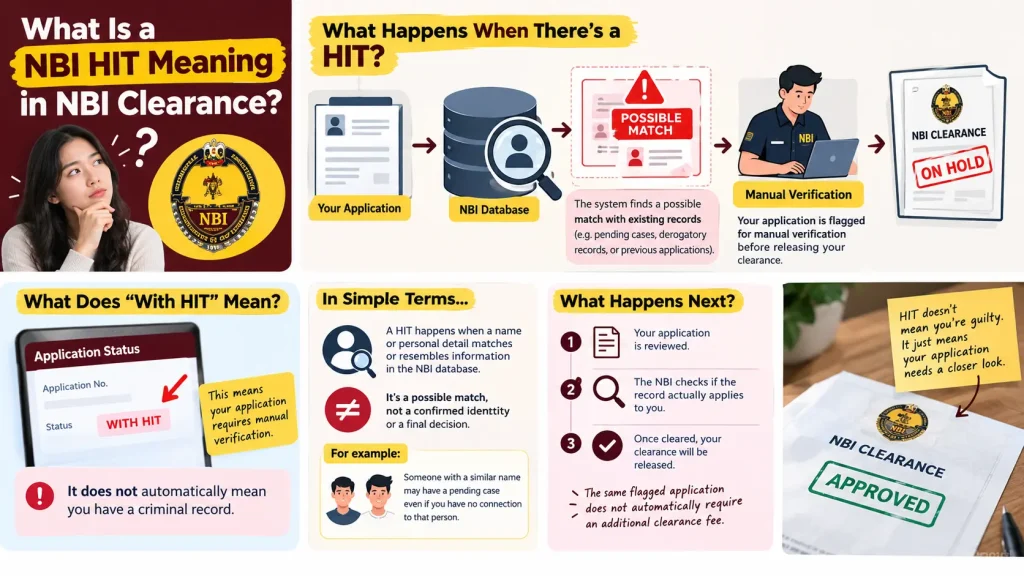
A HIT in NBI Clearance occurs when the National Bureau of Investigation (NBI) system finds a possible match between your name, birth details, or other personal information and existing records, such as pending cases, derogatory records, or previous applications. The system flags your application for manual verification before releasing your clearance.
Moreover, if you want to know how to apply for an NBI Appointment in complete detail, visit our Home Page.
What Does “With HIT” Mean in NBI Clearance?
A HIT in NBI Clearance occurs when the National Bureau of Investigation (NBI) system finds a possible match between your name, birth details, or other personal information and existing records, such as pending cases or previous applications. When your status shows With HIT, your application requires manual verification before your clearance can be released.
Ano ang HIT sa NBI meaning? In simple terms, this happens when a name or personal detail in your application matches or resembles information in the NBI database. It does not automatically mean that you have a criminal record.
A HIT indicates a possible match, not confirmed identity or a final decision. For example, someone with a similar name may have a pending case even if you have no connection to that person. Your application must be reviewed to determine whether the record actually applies to you, and the same flagged application does not automatically require an additional clearance fee.
Types of NBI HIT
Not every HIT is the same, and the type that applies to you determines both the process and the timeline.
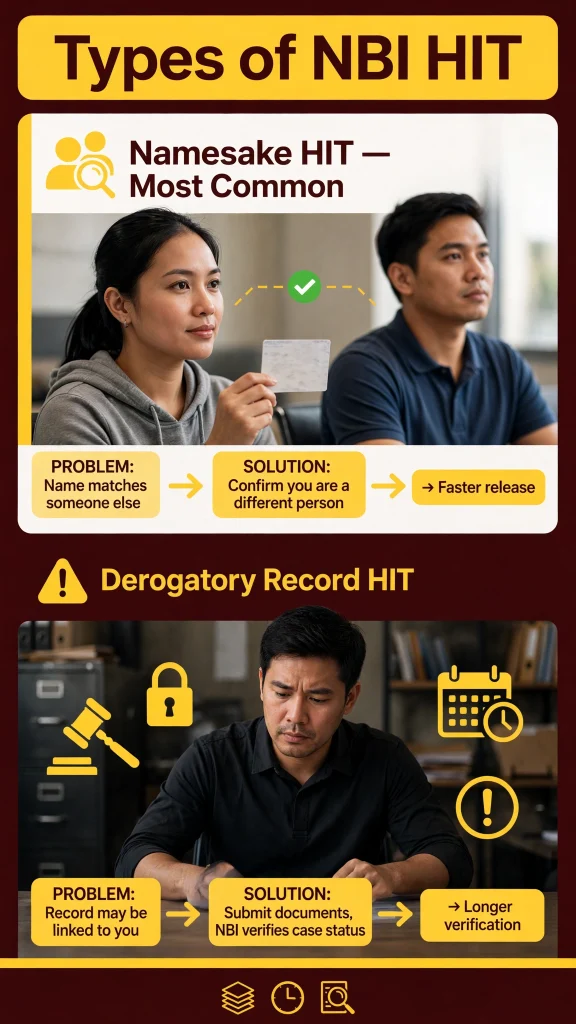
Namesake HIT (Most Common)
A namesake HIT, also called a common name hit, happens when your name closely matches someone else’s record in NBI’s database, and that other person is the one connected to the flagged record, not you. This is by far the most frequent cause of a HIT, since common Filipino surnames and first names repeat across millions of records nationwide. A namesake HIT generally resolves faster than a derogatory HIT, since it’s a matter of confirming you are a different person, not evaluating an actual case tied to your identity.
Derogatory Record HIT
A derogatory HIT means the flagged record may genuinely be connected to you, a past or present case, whether dismissed, resolved, still pending, or in rare cases, tied to an active warrant. This type requires more documentation and a longer verification process, since NBI needs to confirm the current status of that record before deciding how (or whether) to release your clearance.
Outcomes within this category differ sharply depending on whether the case is dismissed, resolved, still pending, or involves an outstanding warrant, covered in detail further down this guide.
What Causes a HIT in NBI Clearance?
Common or Shared Names
Surnames like Santos, Reyes, Cruz, Garcia, and Dela Cruz, paired with common first names, appear in NBI’s database many times over. The system isn’t able to distinguish between two unrelated people with identical or near-identical names on its own, so it flags the match for a human to review.
Partial Name Matches
Even a partial resemblance, a shared middle name and surname with a different first name, for example, can be enough to trigger review, especially when birthdate details are also close.
Old or Inconsistent Records
If your name has been recorded differently across documents, a shortened middle name in one, a full one in another, a maiden name versus a married name, a nickname used on a prior application, the system may treat these as separate identities and flag a possible match that needs manual reconciliation.
Data Entry Errors
Older or legacy records sometimes contain clerical mistakes: a misspelled name, a transposed birthdate, an inaccurate entry from years ago. These errors can create a false match that has nothing to do with any real case connected to you.
Registering a New Account Instead of Logging Into an Existing One
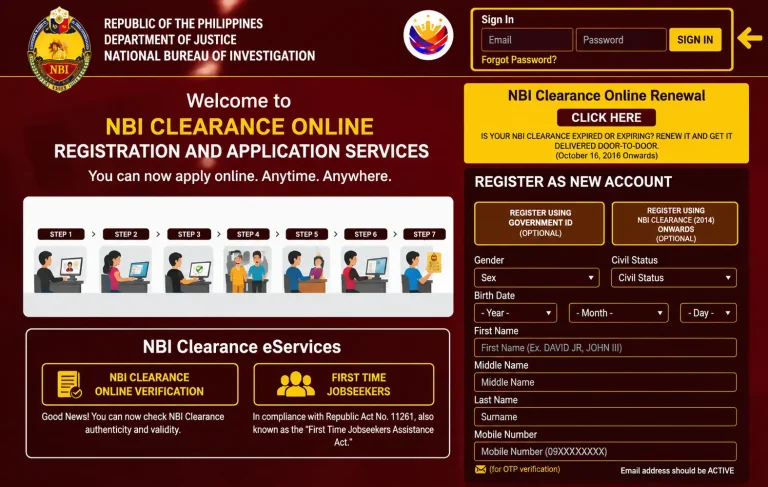
If you’ve applied for NBI Clearance before and create a brand-new account for a renewal instead of signing into your existing one, the system may read this as two separate identities, especially if any detail (spelling, middle name format) differs even slightly between the two records. Always use the Sign In option if you’ve applied before; use Register only if this is genuinely your first NBI Clearance application. NBI HIT Due to Unpaid Loan
This is a commonly repeated claim online, but it does not hold up to scrutiny. The NBI Clearance HIT system cross-references criminal and legal records, cases from courts, the Prosecution Service, the Ombudsman, police, and similar sources, not civil debts or private loan defaults. An unpaid personal loan is a civil obligation, not a criminal one, and on its own isn’t the kind of record that triggers a HIT. The only exception is if the unpaid debt escalates into a criminal matter, for example, a bounced check case filed under the Bouncing Checks Law (B.P. 22), which is a criminal offense distinct from the underlying debt itself. A simple unpaid loan with no related criminal filing will not appear on your clearance.
Does a Civil Case Trigger a HIT?
Generally, no. Purely civil matters, debt collection, annulment, child custody, property disputes, and breach of contract do not automatically enter NBI’s database and will not, by themselves, cause a HIT. NBI’s clearance system is built around criminal and derogatory records, not civil litigation.
When Can a Civil Case Trigger an NBI Clearance HIT?
The exception: if a civil case results in a court-issued warrant, hold-departure order (HDO), or contempt order, that specific order can enter NBI’s database because it restricts your liberty or mobility, not because the underlying case is civil. In that narrow situation, a HIT can occur even though the root matter started as a civil dispute.
Similarly, if a civil dispute escalates into a related criminal charge (for example, a fraud case stemming from a contractual disagreement, which could lead to an estafa charge), that criminal component, not the civil case itself, is what triggers the HIT.
Can a Civil Case Affect Your NBI Clearance?
Bottom line: an ordinary civil case sitting in court on its own will not flag your NBI Clearance. A civil case that has produced a warrant, HDO, or contempt order, or that has a criminal charge attached to it, can.
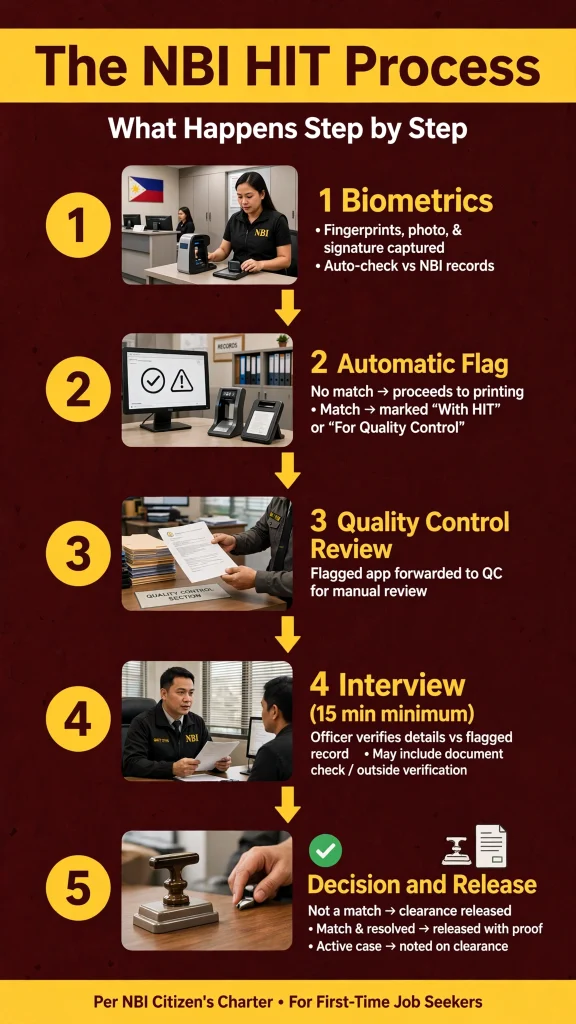
The NBI HIT Process (What Happens Step by Step):
NBI HIT: How Many Days to Clear?
There is no single fixed number of days that applies to every HIT. NBI does not publish one universal timeline because resolution depends on your specific case type and how quickly any required documents (like a court certification) can be confirmed.
Situation | What generally happens |
Simple namesake HIT, no supporting documents required | Often resolved within about a week once Quality Control confirms you’re a different person |
Derogatory HIT with a dismissed or resolved case | Takes longer, since you’ll need to submit certified court documents before release |
Derogatory HIT with an active/pending case | Clearance is typically issued with the case noted, rather than withheld indefinitely |
Derogatory HIT tied to an active warrant | Treated seriously; resolving the underlying warrant is a separate legal matter from the clearance application itself |
If it’s been more than two weeks since your Quality Control interview with no update, follow up directly at the branch where you applied rather than waiting indefinitely.
Can You Pay to Expedite a HIT Resolution?
No. There is no legitimate “express” option that speeds up HIT-specific verification. Paying for express processing covers printing and releasing a clean clearance faster; it has no bearing on how quickly Quality Control can confirm your identity against a flagged record, since that depends on document checking and, in some cases, a court’s response time. Be cautious of anyone, online or at a branch, offering to “fix” or speed up a HIT for a fee; this is not an official NBI service.
Documents You May Be Asked to Submit for NBI HIT
What you need depends on your specific HIT type. Bringing the wrong set of documents to your Quality Control appointment means a wasted trip.
Generally required for any HIT:
If your HIT is linked to a dismissed or resolved case:
If you believe the HIT belongs to someone else entirely (namesake/mistaken identity):
How to Check If You Have a HIT in NBI
NBI HIT List ( Where to Check):
There is no public “NBI HIT list” or pre-application checker. NBI has confirmed this directly in an official Freedom of Information response published on the government’s own FOI portal: an applicant can only find out whether they have a HIT status the moment they apply for a clearance, not beforehand. If you see a site advertising an “NBI HIT checker” that promises to tell you your status before you apply, that is not an official NBI service.
Where you actually find out:
NBI With HIT Sample
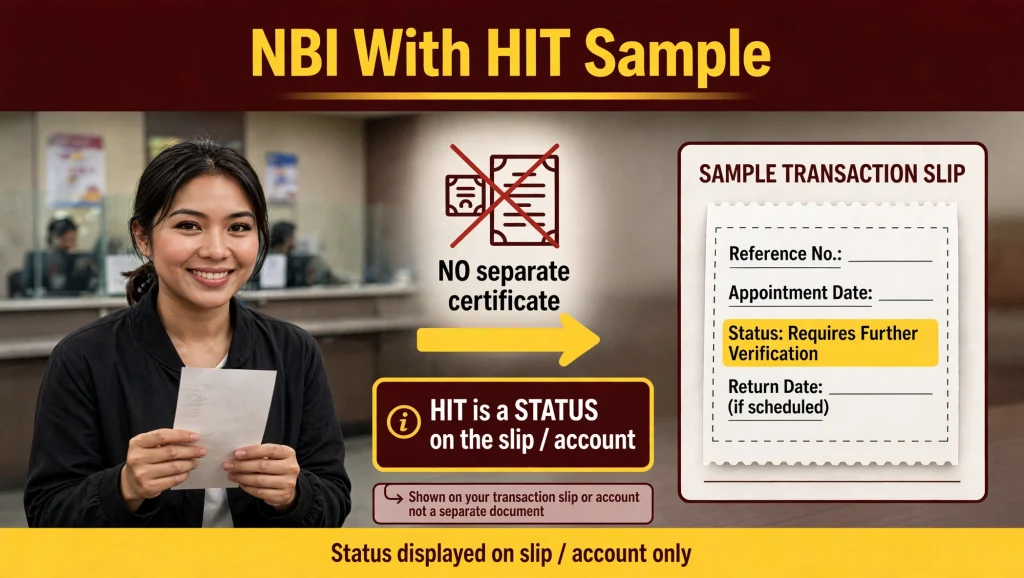
A HIT doesn’t have a special printed certificate of its own, it’s a status shown on your transaction slip or account, not a separate document. The slip will typically show your reference number, the date of your appointment, and a note that your application requires further verification, along with a return date if one has been scheduled.
How to Resolve a Namesake HIT?
How to Resolve a Derogatory Record HIT?
Dismissed Case
If the matched case was dismissed or you were acquitted, bring a certified true copy of the court’s dismissal or acquittal order to your Quality Control interview. Once verified, your clearance is generally released without any notation of the past case.
Resolved Case
If the case has been resolved in some other way (settled, archived, etc.), bring whatever official court documentation reflects that outcome. NBI’s database doesn’t automatically update when a court resolves a case, so the documentation has to come from you unless the court itself has already formally transmitted the update.
Active / Pending Case
If the case connected to the record is still active, NBI cannot clear it from your record, because it genuinely reflects your current legal status. In this situation, your clearance may still be issued, but it will note the pending case. Resolving the underlying legal matter is a separate process from the NBI Clearance application itself.
NBI HIT While Applying From Abroad
Resolving a Namesake HIT From Abroad (Consulate Authentication)
If you’re overseas and receive a HIT while applying through the mailed-clearance process, you’ll typically need to prepare your Affidavit of Denial, have it notarized locally, and then have it authenticated through the Philippine Consulate or Embassy nearest you, before submitting it to NBI in Manila. Since all overseas applications route through NBI’s Main Office, expect this process to take longer than an in-country resolution simply due to mailing and authentication timelines.
What a HIT Means for Canadian Immigration Applications
If you need your NBI Clearance for a Canadian immigration application (such as Express Entry), a HIT delays issuance of the clearance itself, it doesn’t separately flag your immigration file. Once your clearance is cleared and released by NBI, it carries no notation of the HIT and can be submitted normally, provided it still falls within whatever validity window your specific application requires (IRCC generally wants a police certificate issued no more than six months before submission).
What a HIT Means for Other Overseas Applications
The same principle applies regardless of destination country, whether you’re applying for a US visa, Gulf employment, or any other overseas process: a HIT only affects how long it takes to get your clearance, not the clearance’s validity or appearance once it’s issued. Build extra processing time into your timeline if you’re applying from or for use in another cou
If Your HIT Still Isn’t Resolved
Tips to Avoid a HIT on Future Applications
HIT vs. No Hit: Quick Comparison
Aspect | No Hit | With HIT |
What it means | No match found in NBI’s records | A possible name or record match was found |
Next step | Straight to printing | Referred to Quality Control for interview/verification |
Typical timeline | Same day | Varies by case type; no fixed number of days |
Extra fee | None | None (same application fee covers review) |
Appears on final clearance | N/A | No, once resolved, the clearance shows no trace of the HIT |
FAQs
NBI HIT: how many days?
There’s no single fixed number. A simple namesake HIT is often resolved in about a week; cases involving court documents take longer, since NBI must wait on verified records.
How to clear NBI HIT status online?
You can’t resolve a HIT entirely online. You’ll need to appear in person for the Quality Control interview; checking your status online (via your NBI account) is possible, but resolution itself requires an in-person verification step.
What is a hit in NBI clearance?
A flag the system raises when your name or details closely match an existing record, requiring manual verification before your clearance can be released.
What does “with HIT” mean in NBI?
It’s the status shown on your application once it’s been flagged for manual review, same meaning as a HIT, just the specific wording used on receipts and online accounts.
How to check if you have a HIT in NBI?
You generally find out at your appointment, on your transaction receipt, or through your online account. There is no pre-application checker; NBI has confirmed through an official FOI response that status is only known once you apply.
What causes a HIT in NBI clearance?
Most commonly, a common or shared name. Other causes include partial name matches, inconsistent old records, data entry errors, and registering a new account instead of signing into an existing one.
How to expedite NBI clearance with a HIT?
You can’t pay to speed up HIT-specific verification. The fastest path is having your documents (ID, old clearance, court documents if relevant) ready and complete before your Quality Control interview.
What happens if you have a HIT in NBI?
Your application moves from automatic processing to manual review. It is not a rejection; most HITs, especially namesake cases, resolve without issue.
Does a HIT mean I have a criminal record?
No. A HIT only means your name or details resembled something in NBI’s database closely enough to need human confirmation.
Does a HIT mean there’s a warrant for my arrest?
Not usually. A HIT can stem from a namesake match, a dismissed case, an old unrelated record, or in rare cases, an active warrant. If NBI specifically informs you that your HIT relates to a warrant or an active criminal case, that should be treated seriously and may require legal advice, but this is not the typical outcome.
Will a civil case show up on my NBI Clearance?
Generally no. Pure civil matters (debt, annulment, custody, property disputes) don’t trigger a HIT. The exception is when a civil case has produced a warrant, hold-departure order, or contempt order, or when it has an attached criminal charge; those specific elements can enter NBI’s database even though the root case started as civil.
Will a HIT affect my clearance’s one-year validity?
No. Once issued, a clearance is valid for one year from its date of issuance, regardless of whether it required HIT resolution beforehand.
Will my employer know I had a HIT?
No. Your released clearance carries no trace of a HIT once resolved, so there’s nothing on the document itself indicating you were ever flagged.
Why do I have a HIT in NBI every time I renew?
If your name is common, you may be flagged on each renewal, since the system re-checks against records each time. Keeping your name format, spelling, and middle name consistent across applications, and bringing your old clearance, can help speed up each recheck.
Ano ang hit sa NBI?
Ang hit ay flag na ibinibigay ng sistema kapag may katulad na record sa database. Hindi ito kaagad nangangahulugan ng criminal record, kailangan lang itong i-verify nang personal.
Conclusion
The NBI HIT meaning is simple: the NBI system has found a possible match in its records that needs further verification. A HIT is not a verdict, a confirmed criminal record, or proof that the information belongs to you. Many namesake matches can be resolved once the NBI confirms that the record is unrelated to you.
To avoid unnecessary delays, attend your Quality Control appointment as instructed, bring the required documents, answer questions honestly, and keep a copy of your previous clearance for reference. Once verification is complete, follow the NBI’s instructions for clearance release. Remember, having a HIT does not automatically mean you have a criminal record; the outcome depends on the NBI’s verification.